What we build.
What's coming.
Alongside our regular operations, we actively research and develop new detection methods. Here is a transparent view of what's in the pipeline — from research to near-launch.
In-House AI Research
Models we train ourselves — on Lower Saxony's specific landscape, plants, and wildlife.
AI Weed Detection — Ragwort
Ragwort doesn't stop being dangerous once it's cut and dried — its liver-damaging alkaloids survive fully intact in hay and silage, and animals lose the bitter smell that normally makes them avoid the fresh plant in a pasture. That makes contaminated hay one of the most common causes of chronic, often irreversible liver poisoning in horses, and a real risk for cattle. Our custom-trained model flies the field before harvest and flags every plant it finds — on a map, with photos and coordinates.
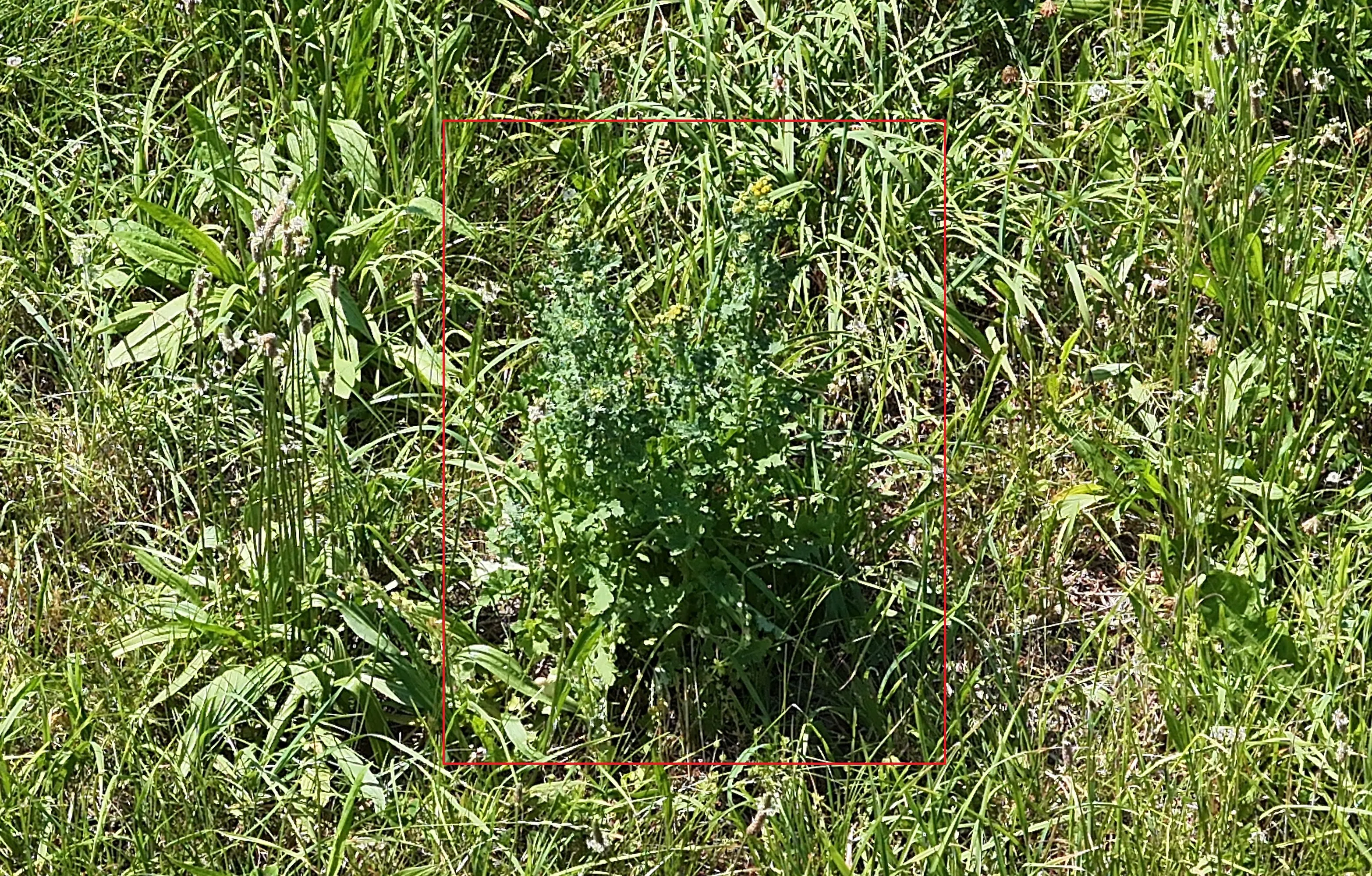
Two-Phase Detection Roadmap
- Phase 1 — flowering stage (Jun–Sep): distinct yellow clusters, in active training now
- Target: ≥90% detection confidence per plant
- Phase 2 (planned): pre-flowering rosette stage — leaf shape only, no colour signal, a significantly harder and costlier model to train
- Data collection and validation ongoing with pasture owners across Lower Saxony
Planned Output (at launch)
- Field photos with every detected plant marked and a confidence score
- Interactive GPS map with ±2 cm RTK coordinate per plant
- Infested area in m², density heatmap
- CSV / GeoJSON for precision spray systems
- PDF report — ready for authority notification, or to document a ragwort-checked field for hay buyers
Who This Helps
- Hay producers & sellers — document your fields before harvest and back your marketing with real field data
- Horse & livestock owners — horses are especially vulnerable; catch contamination before it reaches the paddock or the barn
- Pasture & landowners — meet regional control obligations and get ahead of reseeding (100,000+ seeds per plant, viable in soil for up to 20 years)
New Services
Concept and output defined — launch is imminent.
Electric Fence Condition Analysis
A single drone flight delivers a complete GPS condition map of your fencing — both electrical and physical. Ideal for horse paddocks, pasture fences, and solar parks with perimeter protection.
Thermal Analysis (Electrical)
- Voltage leaks and earth faults (hotspots)
- Faulty insulators and breaks
- Discharged or dead sections
- Earthing faults at the fence unit
Visual Condition Analysis (Physical)
- Broken or missing wires / tape
- Leaning, rotten, or missing posts
- Missing or damaged insulators
- Vegetation overgrowth (short-circuit risk)
- Gaps in fencing (escape risk)
+ PDF with maintenance priority · portal access for follow-up flights
Solar & Facade Cleaning
Not a fully automatic robot — a certified drone pilot plans and flies every session. What it replaces is scaffolding, cherry pickers, and rope-access crews: heavy-lift drones with deionised water reach PV arrays and glass facades in a fraction of the time, at a fraction of the cost, with the site still running throughout.
Why Drone Cleaning
- Faster — a two-person crew clears a full PV park or facade in the time a manual team needs for a fraction of it
- Cheaper — no scaffolding, cherry pickers, or rope-access technicians to hire, insure, and schedule
- Restores lost output — dust, pollen, and bird droppings quietly reduce panel yield; regular cleaning recovers that energy and pays for itself over time
- Contactless & streak-free — deionised water only, no brushes or detergents, so coatings and manufacturer warranties stay intact
Evaluation Focus
- Partnership with heavy-lift drone providers
- Deionised water system for streak-free cleaning
- Scalability: from single sites to 100+ ha
- Certification requirements for water use
Use Cases
- Open-field photovoltaics (PV parks)
- Agri-PV and rooftop solar
- Glass facades and atriums
- Noise barriers with photovoltaics
Launching soon in Lower Saxony — get in touch now to ask questions or line up a pilot site.
Wind Turbine Inspection
Tower, nacelle, and blades from the air instead of by rope access — with 112× hybrid zoom and 640×512 thermal. We already fly that equipment on other missions. What is missing is the first turbine: we are looking for a wind farm in Lower Saxony for a pilot flight.
What the flight would capture
- Blades: leading-edge erosion, cracks, coating condition
- Lightning-strike sites and receptor condition
- Tower and foundation: corrosion, welds, paint condition
- Nacelle and junction boxes: externally visible heat anomalies
What has to be settled first
- Written consent from the turbine operator — mandatory for energy installations (§ 21h LuftVO)
- Rotor stopped and locked — a blade inspection is not possible with the rotor turning
- Written confirmation that our liability cover extends to work on energy infrastructure
- Agreement with your maintenance team on severity classes and report format
We are looking for a pilot site in Lower Saxony — ideally a community wind farm. First mission at cost, findings reviewed together with your team.
Interested in one of these services?
Get in touch — we'll notify you as soon as a service is available in your region, or discuss a pilot mission.
Request a Mission Brief
Describe your site and objectives. We'll respond within 24 hours with a tailored proposal.
Thank you for reaching out!
Your mission brief has been received. We'll get back to you within 24 hours with a tailored proposal.